
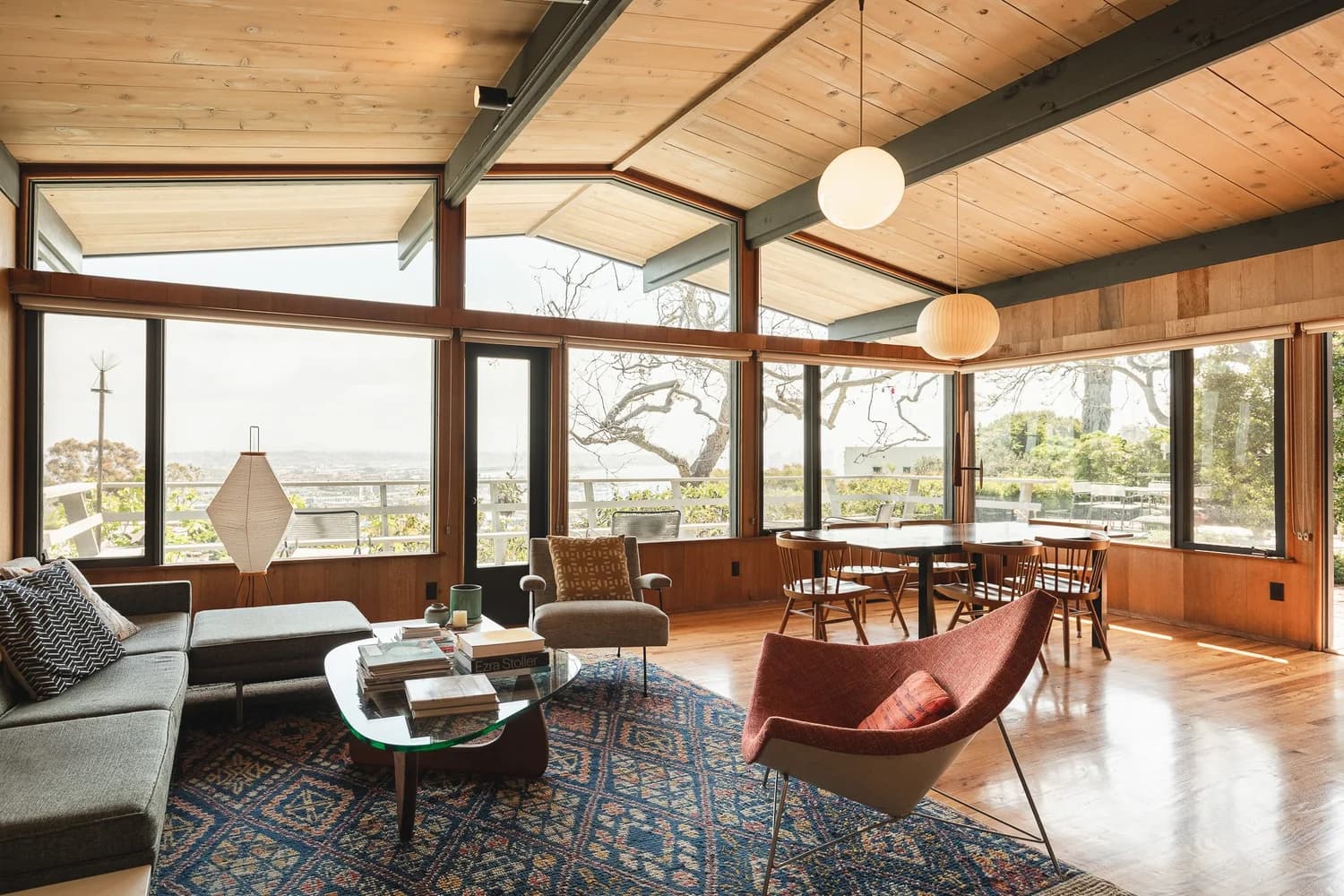
A Different Kind of California Modernism
When people picture California mid-century modern architecture, the image that usually comes to mind is Los Angeles: the glass-walled Case Study houses, the flat roofs perched dramatically over the hills, an architecture of display. San Diego, and La Jolla in particular, produced something quieter and less photographed but arguably just as significant, a strain of modernism more interested in blending into its site than announcing itself from it.
La Jolla hosted the offices of a genuine cluster of talented mid-century architects, including Henry Hester, Sim Bruce Richards, Russell Forester, and Frederick Liebhardt, who collectively designed some of the region's most distinctive homes and civic buildings during the postwar decades. What united much of their work wasn't a shared style so much as a shared instinct: buildings that responded to San Diego's specific climate, light, and topography rather than importing a look from somewhere else.
The Taliesin Connection
Two of the era's most influential local architects, Sim Bruce Richards and Frederick Liebhardt, both trained directly under Frank Lloyd Wright at Taliesin before establishing their own practices in San Diego. That lineage shows up clearly in their work through what's often described as an organic approach, buildings designed to feel like they grew out of their site rather than being placed on top of it, with natural materials, deep integration with landscaping, and a resistance to the hard, glossy surfaces that characterized more mainstream mid-century modernism elsewhere.
Richards, working closely with fellow architect John Reed, designed a notable cluster of organic modernist homes in Point Loma that remain some of the more compelling and lesser-known examples of Wright's influence carried forward by a genuinely independent voice rather than a direct imitator. These aren't houses that try to look like Taliesin West transplanted to a San Diego hillside. They're an interpretation of Wright's underlying principles, deference to site, honesty of material, a sense of shelter, applied to a completely different climate and landscape.
Lloyd Ruocco and the Design Center
No account of San Diego's modernist architecture is complete without Lloyd Ruocco, whose Design Center in Hillcrest remains one of the era's iconic and most understated buildings. Ruocco's work was defined by minimalism, a deep respect for the surrounding landscape, and an emphasis on sustainability that reads today as remarkably forward-thinking for its era. He wasn't chasing the dramatic cantilevers or the glass-box drama of some of his Los Angeles contemporaries; his buildings tend to sit low, use natural light carefully rather than flamboyantly, and prioritize how a space actually functions for the people living or working in it over how it photographs.
That restraint is a big part of why Ruocco's buildings, and much of San Diego's mid-century modern stock generally, don't carry the same instant name recognition as the celebrated Case Study houses further north, even though the architectural ambition and craft are comparable. It's an architecture built to be lived in first and admired second.
La Jolla Before It Opened Up
It's worth understanding the social context these buildings emerged from, because it shapes how the neighborhood actually developed. Through the first half of the twentieth century and into the postwar years, La Jolla was known primarily as an idyllic seaside resort town and a bastion of old money, and for a significant stretch of that history, racial and religious minorities were effectively excluded through restrictive housing covenants common to exclusive communities of that era across the country.
What changed the town's trajectory, and not coincidentally, created the intellectual and cultural environment that supported this wave of architectural experimentation, was the arrival of major research and educational institutions: the University of California, San Diego, the Salk Institute, and the broader research and academic community those institutions attracted. An influx of scientists, professors, and artists gradually forced La Jolla to open up beyond its old-money resort-town identity, and that new population, educated, design-literate, and less bound to the area's older social conventions, became a natural client base for architects working in a genuinely modern idiom rather than the traditional Spanish Revival and Mediterranean styles that dominated much of coastal Southern California at the time.
What Organic Modernism Actually Looked Like
Walking through the surviving examples of this era today, a few consistent traits stand out. Rooflines tend to be low and often sloped rather than the flat roofs associated with more international-style modernism. Natural materials, wood, stone, brick, dominate over the steel and glass that defined the more industrial strain of the movement. Homes are frequently sited to preserve existing trees and topography rather than grading a lot flat, and window placement tends to be deliberate and view-specific rather than simply maximizing glass for its own sake. The overall effect is buildings that feel distinctly of their place in a way that's harder to achieve with a more universal architectural language.
How This Compares to Palm Springs Modernism
It's a useful comparison because Palm Springs modernism has become so much more widely recognized as a cultural and architectural brand. Palm Springs' postwar architecture, Albert Frey, the Alexander Construction Company's tract homes, William Krisel's butterfly roofs, was largely built for a resort and second-home market, designed to read as glamorous and distinctly of the desert, and it has benefited enormously from decades of deliberate civic branding, festivals, tours, and preservation advocacy that turned the whole city into something of an architectural tourist destination.
La Jolla's modernist architecture emerged from a different set of forces entirely: a resident, largely academic and professional population building primary homes to live in year-round, in a coastal rather than desert climate, without the same coordinated civic push to brand the city around its architecture. The result is a body of work that's arguably just as significant but far less commodified, which cuts both ways. It means these homes haven't been swept up in the kind of speculative attention that's inflated some Palm Springs prices well beyond their neighbors, but it also means fewer resources have historically gone toward documenting, surveying, and protecting the full inventory of significant buildings, some of which have undoubtedly been lost to remodeling or demolition simply because their significance wasn't widely recognized at the time.
Why So Few of These Homes Get Torn Down
Well-preserved examples of this era carry a kind of value that's difficult to fully capture in a comparable-sales analysis. Part of it is scarcity, there's a finite and shrinking supply of homes by architects with this level of documented pedigree and craftsmanship. Part of it is that many of the best examples have picked up local historic designation over the years, which protects them from demolition but also means any new owner takes on real responsibility for maintaining a piece of the city's architectural history rather than treating the property as a teardown lot with a house on it.
That designation status is worth understanding clearly before buying one of these homes. It generally protects the exterior character and, depending on the level of designation, sometimes significant interior elements, which can mean a more involved approval process for renovations than a typical home would require. For the right buyer, someone who values the architecture as much as the address, that's a feature rather than a limitation. For a buyer primarily interested in maximizing square footage or making major structural changes, it's an important constraint to know about upfront.
What to Look For If You Want One
Buyers interested in this category of home should start by researching the architect and the building's designation status, since both materially affect what you can do with the property and how it should be valued. Original, unaltered examples with intact materials, wood siding, original windows, period-appropriate finishes, generally command a premium over homes that have been heavily remodeled, even when the remodels were done tastefully, because architectural authenticity is increasingly part of what buyers in this category are actually paying for. It's also worth working with an agent or inspector who understands the specific maintenance realities of homes this age, since deferred maintenance on original materials can be more costly to address correctly than it would be on a conventional home where matching materials isn't a concern.
The Legacy Today
What makes San Diego's mid-century modern architecture worth understanding isn't just its market value, though well-documented examples do command real premiums. It's that this small cluster of architects, working quietly and without the same national spotlight as their Los Angeles counterparts, built a genuinely coherent regional architectural language, one that responded honestly to San Diego's light, climate, and landscape rather than importing an aesthetic from somewhere else. That's a legacy worth preserving, and worth understanding, whether or not you're in the market to buy one.